60 days.
Measurable AI research.
A proposed NVIDIA Innovation Lab campaign to evaluate transferable engineering knowledge, profile agent inference and build reproducible AI research workflows.
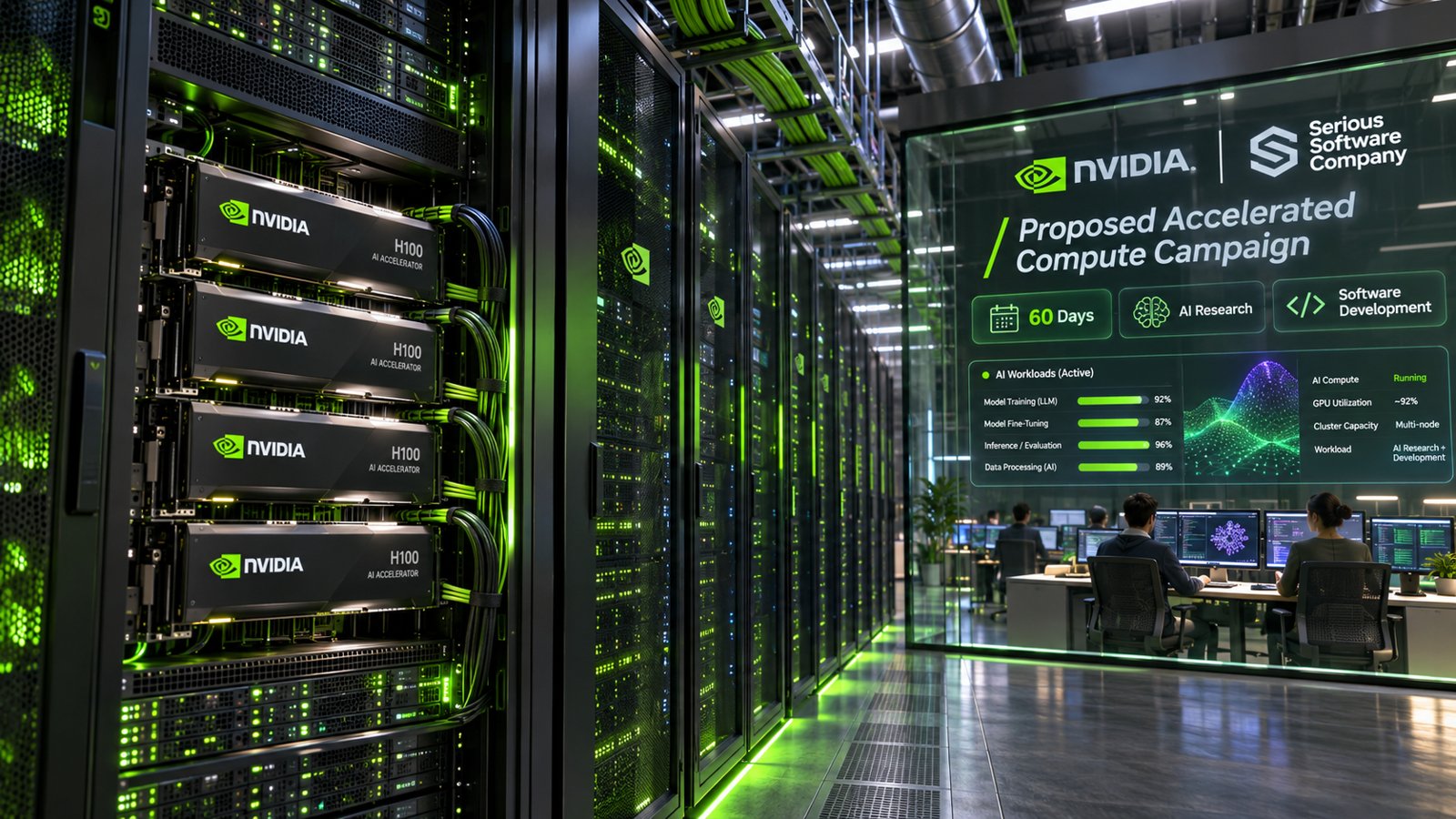
Inception + Innovation Lab.
Two distinct steps: join NVIDIA’s startup ecosystem, then seek access to its time-limited research environment.
Startup ecosystem
Free membership for qualifying incorporated startups with a working website, active founder involvement and an NVIDIA technology use case. Access to training, tools and selected ecosystem offers varies by eligibility.
60-day accelerator
Selected Inception members may receive temporary access to cloud-based NVIDIA accelerated compute, software and technical guidance. Participation requires a separate application; capacity and workload fit determine selection.
Proposed application pathway
- Confirm SSC eligibility and prepare a working website, product profile, pitch deck and clear accelerated-compute use case.
- Apply to Inception. If approved, create at least one product profile in the member portal.
- Find Innovation Lab in the benefits catalog, request the benefit and submit the separate application.
- If selected, confirm actual GPU model, quota, permitted workloads, terms, access window and artifact export conditions before scheduling experiments.
Teach. Transfer. Test.
The question is not whether an agent can memorize a lesson. It is whether preserved knowledge transfers into better decisions on unfamiliar engineering tasks.
Incumbent approach
Measure an existing agent workflow as the reference point.
Strong references
Provide high-quality, searchable technical references without the University package.
Frozen knowledge package
Provide the same references plus a curated, rights-cleared package of techniques, contrasts and engineering cases.
From preparation to evidence.
Prepare outside the allocation window: source permissions, held-out assessment custody, reproducible runners, baseline plans and artifact export. Begin the 60-day clock only after actual access is confirmed.
Establish the baseline
Validate the provisioned environment, profile inference, freeze model and harness versions, establish resource ceilings, test isolated grading.
Run the pilot
Execute the approved screen; capture manifests, failures, tokens, elapsed time and independent task evidence. Analyze uncertainty.
Confirm & optimize
If warranted, preregister a confirmation study. Benchmark batching, memory, latency and throughput without changing comparison conditions mid-test.
Reproduce & transfer
Repeat selected runs, export authorized artifacts, document positive and negative findings, produce a portable continuation plan and complete teardown.
Why GPUs?
Parallel inference and controlled repeated evaluations can reduce experiment wall time. Profile actual bottlenecks and consider appropriate CUDA-enabled runtimes, TensorRT-LLM or NIM, if compatible with the selected models and allocation.
What remains after day 60?
Versioned study material, approved reproducible experiment artifacts, measured quality/cost trade-offs, a technical report and a continuation plan that does not depend on temporary credits.
Accelerated research console.
Switch between the illustrative compute workspace, experiment matrix and evidence ledger to see how the campaign could be managed.
Compute campaign console
Illustrative layout · no GPU instance provisioned by this prototype
Illustrative workload distribution
Illustrative planning mix only; reallocate after hardware, quotas and benchmark costs are observed.
Environment prerequisites
| Gate | Status |
|---|---|
| Access & quota | Unknown |
| Model/runtime | To pin |
| Source rights | To verify |
| Exam isolation | To prove |
| Export & teardown | To plan |
Experiment orchestration concept
Experiment matrix
Pilot 0 proposed screening design · no results
Fresh-agent comparisons
| Arm | Inputs | Purpose | Status |
|---|---|---|---|
| A | Incumbent baseline | Reference point | Planned |
| B | Strong searchable references | Active comparison | Planned |
| C | B + frozen University package | Test incremental transfer | Planned |
Evidence & reproducibility
Proposed outputs and measurable criteria
Measurement ledger
| Metric | Measure | State |
|---|---|---|
| Engineering correctness | Independent tests and rubric | Not measured |
| Transfer | Performance on held-out families | Not measured |
| Efficiency | Latency, tokens and compute per attempt | Not measured |
| Reliability | Failed runs and completion rates | Not measured |
| Portability | Re-run outside time-limited instance | Not measured |
End-of-campaign outputs
Report negative results and uncertainty alongside any measured improvements. Export only materials approved for transfer.
Reusable engineering, practical products.
Raccoon University
Develop and evaluate transferable techniques, not a claim of trained model improvements.
Raccoon Capital
Potential downstream use: reliable research pipelines, evaluation and evidence controls.
WrenchRiot
Potential downstream use: trustworthy agent-assisted workflows, retrieval and structured records.
Program information: NVIDIA Inception · NVIDIA Innovation Lab. SSC research design based on its November 25, 2026 curriculum planning; proposed features and schedule are not commissioned.
Return to the SSC portfolio.
The campaign is a proposed research opportunity, separate from commercial product release.